
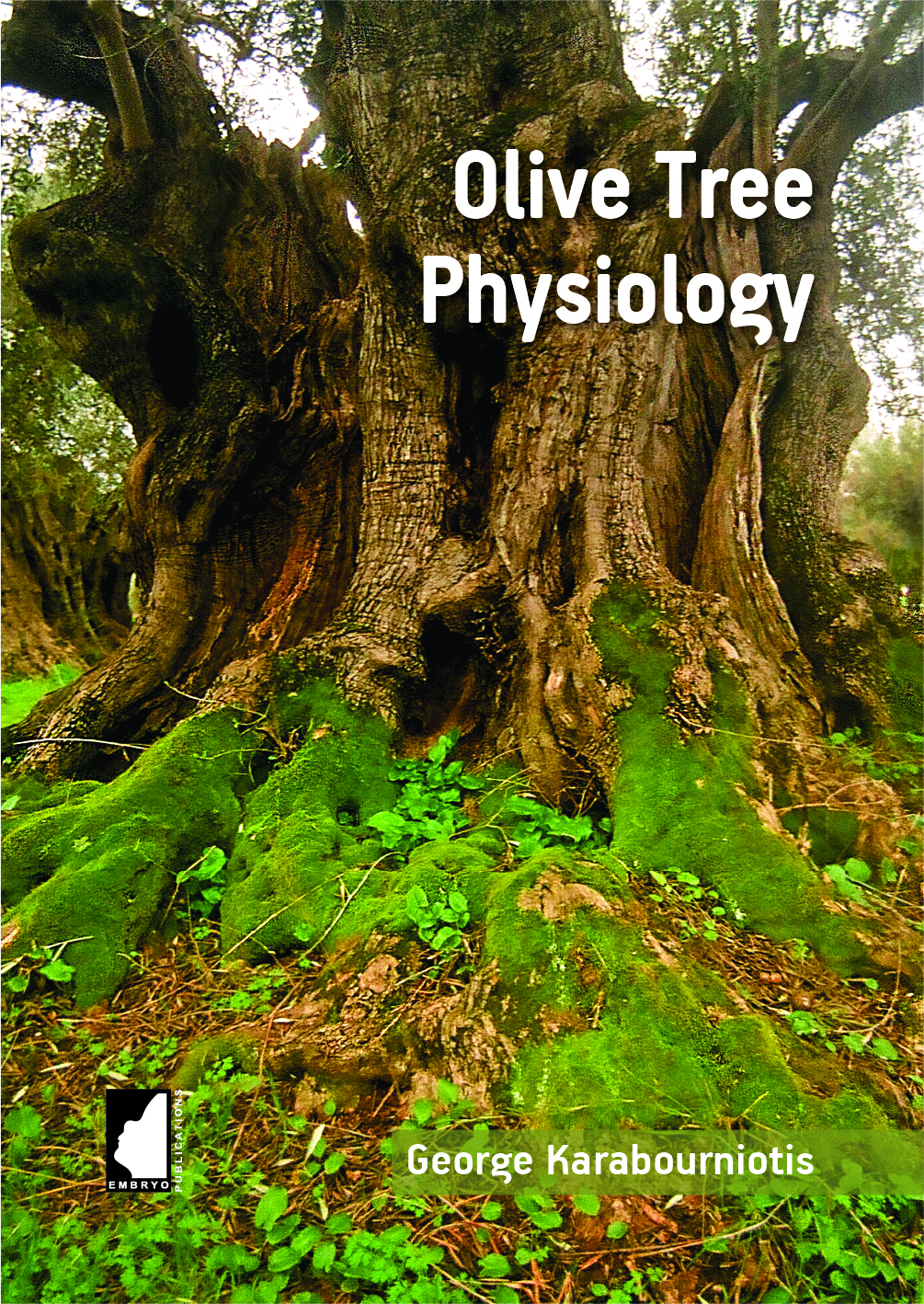
Κάντε click σε μια εικόνα για μεγέθυνση
Olive Tree Physiology
| Κωδικός Προϊόντος | 001188 |
| Κωδικός ISBN | 9786185252885 |
| Εκδοτικός Οίκος | ΕΜΒΡΥΟ |
| Βάρος | 0,500 kg |
| Διαστάσεις | 17 X 24 |
| Εξώφυλλο | Μαλακό |
| Έτος έκδοσης | 2026 |
| Σελίδες | 262 |
| Συγγραφέας(εις) | George Karabourniotis |
Olive Tree Physiology
Contents
Abbreviations: 15
Acknowledgments 17
A short presentation of this book 19
Why the olive tree? 19
1. The olive tree: A stress-tolerant long-lived crop giving the Mediterranean landscape its unique physiognomy 21
1.1. The olive tree characterizes the unique physiognomy of the Mediterranean landscape 22
S 1.1. The olive tree as a symbol 23
S 1.2. Olive tree longevity 24
S 1.3. Monumental olive trees and the ‘Throuba Naxos’ tree 27
1.2. Olive tree cultivation is marked by significant variability 28
1.3. The main domestication event took place in the southern Levant 29
1.4. The physiology of the olive tree through the concept of functional modules 31
2. The light-capture module: Suitable optical elements enable efficient photosynthesis in a stressful environment 33
2.1. The light-capture module of leaves: Optical properties of the epidermal layer 34
S 2.1. Olive leaf surface and the application of foliar sprays 35
2.2. The light-capture module of leaves: Optical properties of the trichome layer 37
2.3. The light-capture module of leaves: Optical properties of the mesophyll 39
2.4. The light-capture module of bark: Age and rain dependency 41
2.5. The light-capture module of fruit 43
3. The gas-exchange and carbon-metabolism modules 45
3.1. The gas-exchange module: Targeting water economy 46
3.1.1. Leaf photosynthesis follows the C3 mode 46
3.1.2. Bark photosynthesis: High efficiency 46
3.1.3. Fruit photosynthesis: Utilizing the internal CO2 pool 47
3.1.4. Floral photosynthesis is very low 47
3.2. The carbon-metabolism module focuses on oil synthesis 47
3.2.1. Growth rate is determined by the balance between carbon gain and carbon loss 47
3.2.2. Stems and roots provide long-term carbon and energy storage 48
3.2.3. Inflorescences are characterized by high energy and carbon requirements 48
3.2.4. Fruit metabolism focuses on oil synthesis 49
S 3.1. Mannitol characterizes the Oleaceae family members 51
4. The water/nutrient-flow and utilization module 55
4.1. Shallow yet versatile: The root system of the olive tree 56
S 4.1. Drought and cavitation risk 58
4.2. Olive tree bark maintains water reserves 59
S4.2. Arbuscular mycorrhizal fungi symbiosis 60
4.3. The activities of the light-capture and gas-exchange modules are balanced with those of the water/nutrient-flow module 61
4.4. Sap flow of young trees is attuned to gas-exchange rates 61
4.5. Xylem sap carries a diverse array of water-soluble inorganic and organic compounds 63
4.6. Phloem transfers assimilates from the source leaves to the sink organs 63
4.7. The olive tree has low nutrient demands 64
4.8. Nitrogen fertilization is unnecessary in fertile soils 66
4.9. Symptoms of phosphorus deficiency are rarely observed 67
4.10. Deficiency of potassium is a common phenomenon in olive orchards 67
4.11. Deficiency of calcium may appear in non-calcareous soils 68
4.12. Deficiency of iron occurs on calcareous soils 68
4.13. Magnesium 69
4.14. Deficiency of boron is quite common in olive trees 69
4.15. Alternate bearing is affected by nutrient reserves 71
4.16. Nutrient excess causes toxicity symptoms 72
4.17. Beneficial elements may promote olive tree growth 72\
4.18. Symbiosis with AMF plays a critical role in inorganic nutrition of the olive tree 73
5. The defense against biotic stress module is based on a successful structure-function relationship 75
5.1. The opponents: Pathogens endanger olive tree cultivation 76
5.1.1. Pathogens infecting the aboveground part 77
S 5.1. Pseudomonas savastanoi pv. savastanoi 77
S 5.2. Fusicladium oleagineum 80
S 5.3. Pseudocercospora cladosporioides 81
5.1.2. Fruit infections are associated with damage caused by insects 81
S 5.4. Colletotrichum spp. 82
S 5.5. Botryosphaeria dothidea (syn. Camarosporium dalmaticum) 82
5.1.3. Xylem-inhabiting pathogens cause serious damage 83
S 5.6. Verticillium dahliae 83 S 5.7. Xylella fastidiosa 84
S 5.8. Alternaria alternata 84
S 5.9. Phytophthora spp. 85
5.1.4. Viruses 85
5.2. The opponents: Some pests endanger olive tree culture 85
5.2.1. The major damaging pests: Insects 85
S 5.10. Bactrocera oleae 86
S 5.11. Prays oleae 87
S 5.12. Dasineura oleae 88
S 5.13. Euphyllura olivina 89
S 5.14. Saissetia oleae 90
5.2.2. The major damaging pests: Mites 90
5.2.3. The major damaging pests: Parasitic nematodes 90
5.3. Olive trees employ three main defense strategies 91
5.4. Constitutive defense and the growth-defense/protection dilemma 92
5.4.1. Constitutive defense: The biochemical arsenal 94
5.4.2. Phenolics are multifunctional tools 94
S 5.15. Oleuropein, the characteristic multifunctional secondary metabolite of olive trees 96
S 5.16. Some phenolic compounds play a significant role in adventitious root formation 99
5.4.4. Terpenoids (terpenes) 99
5.4.5. Volatile compounds 101
S 5.17. Olive tree leaves have been widely used in traditional herbal medicine. 110
5.4.6. Constitutive defense: Phenolics protect against pathogens and herbivores 111
5.4.7. Constitutive defense: Effective structure-function relationships of superficial aboveground structures 111
5.4.8. Constitutive defense: Effective structure-function relationships of the root system 112
5.5. Induced defense: The response to pathogens 113
S 5.18. Redox-controlling enzymes and olive defensive mechanisms 115
5.5.1. Induced defense: The response of the olive roots to xylem-inhabiting pathogens: Verticillium dahliae infection 115
5.5.2. Induced defense: The response of olive roots to xylem-inhabiting pathogens: Xylella fastidiosa infection 116
S 5.19. Resilient olive groves 117
5.5.3. Induced defense: The response of olive leaves to Fusicladium oleagineum infection 117
5.5.4. Induced defense: The response of olive fruits to Colletotrichum acutatum infection 118
5.5.5. Induced defense: The response of olive stem tissues to Pseudomonas savastanoi pv. savastanoi infection 118
5.5.6. Induced defense: The response of olive leaf tissues to Alternaria alternata infection 119
5.6. Induced defense: The response to pests 119
5.6.1. Induced defense: The response of olive fruits to Bactrocera oleae attack 119
5.6.2. Induced defense: The response of olive leaves to Dasineura oleae attack 120
5.6.3. Induced defense: The response of olive roots to parasitic nematode attack 120
5.7. Indirect defense via tritrophic interactions 120
5.7.1. The olive tree microbiome: The phyllosphere and the phylloplane 120
5.7.2. The olive tree microbiome: Endophytic bacteria thriving in the olive xylem 123
5.7.3. The olive tree microbiome: The anthosphere 124
5.7.4. The olive tree microbiome: The carposphere 124
5.7.5. The seed microbiome 125
5.7.6. The microbiome of olive tree roots 125
S. 5.20. The importance of the rhizospheric microbial community 126
5.8. Indirect defense: Use in developing biological control strategies 126
5.8.1. Indirect defense via tritrophic interactions in belowground parts 127
5.8.2. Indirect defense via tritrophic interactions in aboveground parts 128
S 5.21. Tritrophic interactions: Olive, pests and natural enemies. Use in developing biological control strategies 130
5.9. The breakdown of defense by opponents 131
5.9.1. Some pathogens bypass the constitutive defense of superficial structures via wounds or openings 131
5.9.2. Some pests harbor bacterial microbiota that detoxify defensive metabolites found in olive fruit 131
5.9.3. Botryosphaeria dothidea requires a vector to infect olive fruit 132
5.10. Overfertilization promotes infection and pest attack 132
6. Efficient reproduction (and yield) depends on sufficient reserves 135
6.1. The FLOWERING LOCUS T (FT) protein is implicated in flower induction 136
S 6.1. The color of olive flowers 136
S 6.2. Do olive tree buds exhibit physiological dormancy? 141
S 6.3. Juvenility in olive trees 142
S 6.4. Olive tree pollen and allergies 143
6.2. Fertilization: Self- and cross-incompatibility in olive trees 143
6.3. Fruit development 145
S 6.5. Fruit cuticle characteristics and pest resistance 146
S 6.6. Olive oil composition and health benefits 149
S 6.7. Squalene and its uses 149
S 6.8. Olive oil aroma and flavor 150
6.4. Seed dispersal and seedling survival 150
7. Acclimation of olive trees to stress conditions 153
7.1. Acclimation to water stress 154
7.1.1. Short-term acclimation 154
7.1.2. Long-term acclimation 155
S 7.1. Cross tolerance: Drought induces tolerance to pathogens and heat stress 157
7.1.3. Symbiosis with AMF helps to alleviate water stress through a combination of anatomical and physiological effects 158
7.2. Acclimation to salinity 158
7.2.1. Short-term acclimation 158
7.2.2. Long-term acclimation 160
7.3. Acclimation to elevated temperatures 161
7.3.1. Short-term acclimation 162
S 7.2. The function of heat-shock proteins 163
7.3.2. Long-term acclimation 164
7.4. Acclimation to low temperatures 166
7.5. Acclimation to altered light regimes 168
7.6. Acclimation to mechanical stress 170
7.7. Acclimation creates stress memory 170
S 7.3. Grafting on wild olive trees 173
7.8. Heavy metal exposure 173
7.9. Efficient combination and functional integration of the modules 174
8. Coordination of the functional modules, amongst themselves (internal coordination) and with the prevailing ambient conditions 177
8.1. Coordination of the functional modules during development 178
8.1.1. The regulation of development and the transition from germinating seed to juvenile plant 178
8.1.2. The regulation of the development and the juvenile-to-adult plant transition 179
8.1.3. The regulation of fruit development 180
8.2. The coordination of functional modules during acclimation and priming 181
8.2.1. Signal transduction during acclimation and priming to salinity 181
8.2.2. Signal transduction during acclimation and priming to water stress 182
8.3. Sensing the reserves: The regulation of alternate bearing 182
9. Possible effects of climate change on functions in olive trees 185
9.1. The impact of climate changes on olive cultivation: What happened in the past? 186
9.2. The effect of climate change on olive cultivation: What is currently happening? 188
9.3. The effect of climate change on olive cultivation: What could happen in the future? 190
S 9.1. The beneficial effects of kaolin 193
9.4. The interaction with climate change: The environmental impact of olive cultivation 193
Concluding Remarks 195
References 197
Index 243
Generic index 255
Appendix 257
Table I. Olive varieties tolerant of or susceptible to several biotic stress factors. 257
Table II. Olive varieties tolerant of or sensitive to several abiotic stress factors. 260
Table III. Olive varieties with high nitrogen (N) uptake and nutrient translocation efficiency. 261
| Κωδικός Προϊόντος | 001188 |
| Κωδικός ISBN | 9786185252885 |
| Εκδοτικός Οίκος | ΕΜΒΡΥΟ |
| Βάρος | 0,500 kg |
| Διαστάσεις | 17 X 24 |
| Εξώφυλλο | Μαλακό |
| Έτος έκδοσης | 2026 |
| Σελίδες | 262 |
| Συγγραφέας(εις) | George Karabourniotis |